
AI Recruitment Marketing Software: A Buyer Evaluation Guide
Evaluate AI recruitment marketing by the task it performs, the evidence behind its output and the handoff into your hiring workflow.

Evaluate AI recruitment marketing software by the task it performs and the evidence you can inspect. Creative generation, campaign delivery, candidate matching and forecasting are different jobs. Compare the relevant workflow, its inputs, human controls and hiring-system handoff before treating an AI label or a vendor case study as proof of fit.
Use the performance and ROI resource as a starting point for evidence questions, not a promise about your deployment. The same distinction applies to product demonstrations: a task shown in a sales presentation needs to be checked against the workflow, configuration and information your team will actually use.
Key Facts
- An AI label does not establish better hiring performance. Identify the task, inputs, output and human controls.
- Content assistance, distribution, engagement, matching and forecasting require different evaluation questions.
- Keep supplier descriptions separate from independently tested outcomes and from your own acceptance results.
- Historical recognition, such as the archived Fosway 9-Grid Core Leader announcement, does not replace a demonstration of fit.
- A forecast is an estimate with assumptions. It needs later comparison with observed outcomes.
Which recruitment marketing task needs AI assistance?
Begin with a specific operation rather than a broad request to automate recruitment. Content assistance takes approved job information into a draft. Ask what happens when location, working pattern or essential requirements are missing, and who must approve the result before publication.
Distribution takes an approved campaign into selected placements. Inspect the enabled channels, publication controls and operator responsibilities. Engagement takes a known contact into a permitted follow-up workflow. Verify what information establishes eligibility for the intended communication rather than treating every interaction as permission.
Matching uses supplied candidate information to suggest something for review. Ask what evidence is available to the reviewer and what remains unknown. Forecasting turns assumptions and inputs into an estimate. Record those assumptions and the point at which actual applications or hiring outcomes can be compared with the estimate.
Do not assume that one product provides all these tasks or that every purchased configuration includes the same capabilities. The earlier Fosway announcement remains historical context; it is not evidence that a particular task meets your requirements.

How to Evaluate an AI Talent Attraction Platform: Metrics That Matter
Define the events and cohort before comparing a dashboard result. A label such as time to fill can conceal different starting and ending events. Cost measures depend on which costs are included, while post-hire quality measures require enough time for the relevant outcomes to become observable.
| Measure | Definition | Evaluation question |
|---|---|---|
| Time to fill | Time between defined requisition and fill events | Are event definitions and role cohorts consistent? |
| Cost per hire | Included recruiting cost divided by attributed hires | Which costs and attribution window are included? |
| Quality of hire | Defined post-hire outcomes for the eligible cohort | Who measures it and when can it be observed? |
| Application completion | Submitted applications divided by starts | Are both events from the same journey? |
| Source of hire | Recorded source linked to the hiring outcome | How are missing or multi-touch records handled? |
For a Predict evaluation, ask the supplier to distinguish the forecast from the observed result. Record the input information, the assumption being tested and the later outcome check. A forecast can inform a planning discussion without being treated as a guaranteed application volume or hiring result.
Keep missing source data and pending reviews visible. Application completion uses submissions and starts from the same defined journey. Hiring and post-hire outcomes can mature later than campaign activity, so the reporting window must make that lag clear. Do not combine attention, applications and hires into one undifferentiated performance claim.
AI recruitment marketing platforms: roles to compare
The vendors below remain in the existing reading order. This is a description of documented roles to investigate, not an independent test, score or ranking. Ask each supplier to demonstrate the relevant task in the configuration being offered.
Adway
Adway supports Employer Brand Activation and social recruiting workflows. Its Always-On Job Ads documentation describes job-driven creative, channel adaptation and review or automatic publication modes. Check which channels and controls are enabled for the role used in your evaluation.
Social Apply describes registration, screening questions, Smart ScoreCard, optional CV and cover-letter steps, and sync settings. Demonstrate the configured application route and inspect the recruiting-system connection. A named integration does not prove universal field mapping or readiness for every module.
Use Adway’s performance evidence to frame questions about the underlying cohort and cost scope. The retained programmatic advertising resource provides separate background; it does not establish a customer outcome or show that Adway is the best fit for every AI task. For forecasting specifically, inspect the assumptions described in Predict.
Joveo, Phenom, Beamery, Gaia and Wonderkind
Joveo lists job and social advertising, career sites, CRM, campaigns and analytics. Identify the purchased workflow and ask which parts of the demonstration it covers. Do not assume an employer-brand limitation from the product category.
Phenom describes dynamic segments, rediscovery, sourcing support, triggered campaigns and source-to-hire measurement within a wider platform. Trace the selected modules and handoffs rather than reducing the offering to career-site personalisation.
Beamery describes skills-based profiles, talent pools, rediscovery and recruiting workflows integrated with an ATS. Inspect the role of candidate information, data freshness and the ATS connection. Unverified negative reviews are not a substitute for testing the required workflow.
Gaia describes recruitment marketing across social and search, creative, forms, reporting and ATS/CRM connections. Check the proposed configuration without importing supplier performance numbers or treating another vendor’s analyst recognition as proof of inferior performance.
Wonderkind describes recruitment advertising and candidate delivery with social and job-board coverage. Ask which channels and handoffs are included. Avoid inferring a narrow channel limitation or repeating network-size and outcome claims that this evaluation has not established.
Illustrative AI demonstration script
Bring an approved requisition and a deliberately incomplete version. This is an illustrative procurement exercise, not a report of imaginary product outcomes. Keep the same inputs across demonstrations and log each step as pass, needs configuration or not demonstrated, with the observed evidence beside it.
Ask the vendor to generate a draft from the approved requisition. Check that it reflects the supplied role information. Present the incomplete version and ask how missing information is identified rather than silently invented. Then show the human approval step and who can change or stop publication.
Trace the application record and source field through the proposed journey into the hiring system. Ask where information originates, what is transferred and which owner resolves a missing field. Finally, ask the vendor to explain one forecast assumption and how the team would compare that estimate with later observed outcomes.
A missing demonstration is an unresolved requirement, not proof that an entire product lacks the capability. Record configuration dependencies and the evidence needed to resolve them before a purchasing decision.
How to use customer evidence in an evaluation
The Nexer Recruit case and Elits tech talent sourcing case remain further reading. Request the baseline, period, role mix, cost scope, attribution approach and missing data behind any customer evidence considered during procurement. Do not transfer a case outcome to a different employer without understanding those boundaries.
Ask whether the comparison covers the same roles, markets and stages of the process. Establish which operational costs were included and when hiring outcomes became available. A named customer or quotation alone cannot answer those questions. This guide reports no numerical outcomes and makes no claim of independent platform testing.
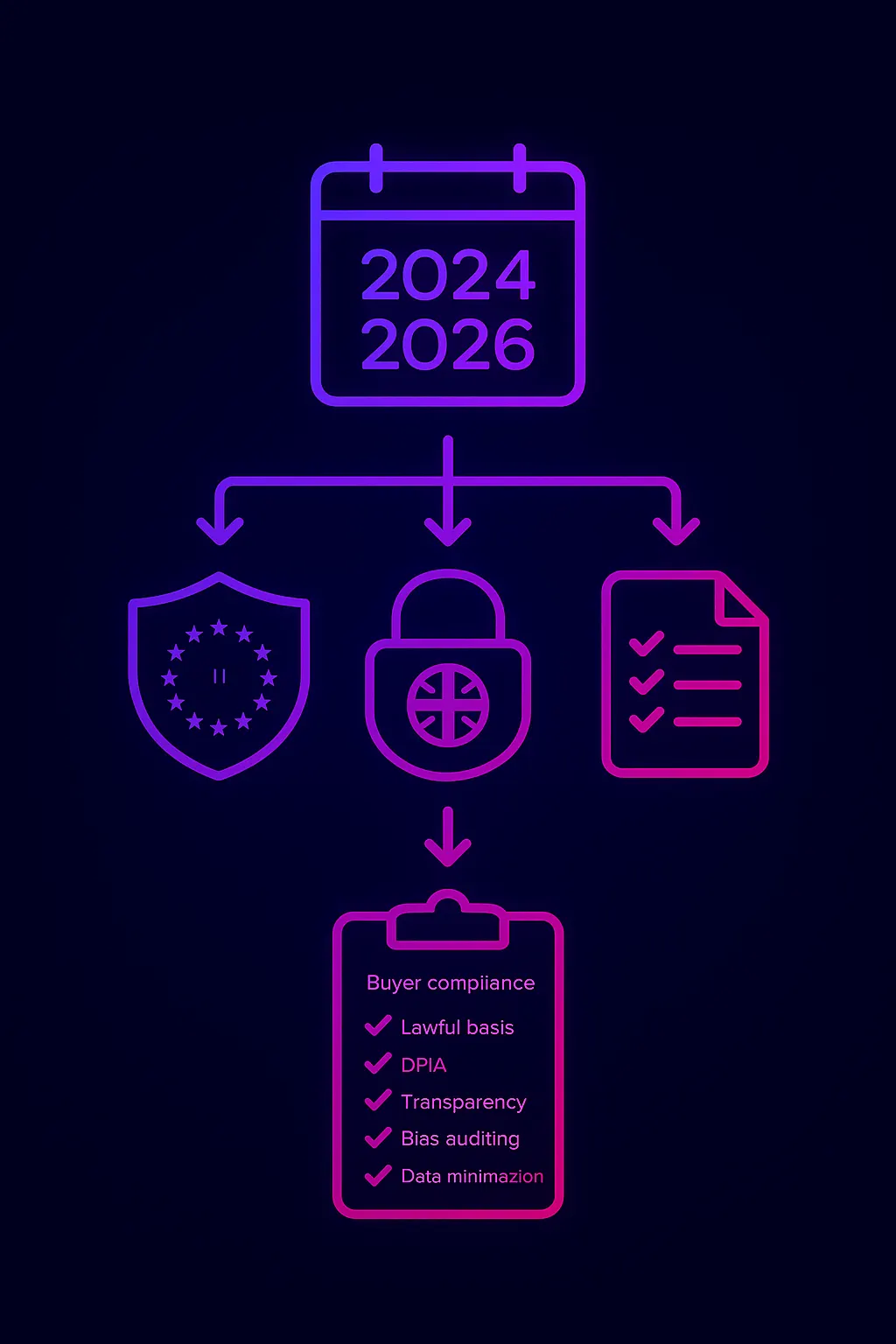
Historical illustration of governance topics; the dates in this graphic are not a current legal implementation timetable.
Historical illustration of governance topics; the dates in this graphic are not a current legal implementation timetable.
What governance evidence should buyers request?
Treat governance as a set of questions about the intended deployment. Marketing language does not establish compliance, and a general statement about a platform does not explain how a particular customer’s data, review controls and responsibilities are configured.
| Evidence area | Question for the vendor |
|---|---|
| Data inputs | What information does this workflow use and where does it come from? |
| Purpose and permission | What use is intended and how is permission or other applicable basis recorded? |
| Transparency | What can a candidate and recruiter see about the workflow? |
| Retention and access | Who can access records and how are correction and deletion handled? |
| Evaluation and review | How is output evaluated and when can a person review or override it? |
| Deployment responsibility | Which obligations and controls belong to vendor and customer for this use? |
These questions support procurement diligence; they are not a legal finding or a declaration that a product meets every requirement. Ask for evidence specific to the task and intended use. Record which controls are demonstrated, which depend on configuration and which responsibilities belong to the customer.
Keep human review visible when evaluating outputs. Ask what information a reviewer sees, how an output is assessed and when it can be overridden. Do not treat an AI feature as inherently bias-free, anonymous or cookie-free. The assessment should describe the actual workflow and its limits without inferring guarantees from a label.
Choosing Your 2026 Tech Stack: Key Takeaways
Choose the task first, then assess the demonstrated inputs, controls and handoff. Keep forecasts distinct from observed outcomes and require consistent definitions for comparisons. Use the performance and ROI evidence and Adway’s solutions as resources for the discussion, not a universal prescription.
For programme and media selection, continue to the existing programmatic recruitment marketing platform comparison. This guide addresses task-level AI evaluation and procurement questions; the programme comparison serves a different decision.
Book a demo to walk through a role, its application journey and the handoff into your recruiting system.
If your shortlist also includes candidate matching, CRM or interview workflows, use our AI hiring platform guide to define the system boundaries and run a role-to-record acceptance test.
For deployment across sites, use the multi-location campaign budget and ownership plan.
Sources
Adway Always-On Job Ads, Social Apply, integrations and Predict documentation; Joveo product documentation; Phenom Talent CRM; Beamery Talent CRM; Gaia recruitment-marketing documentation; and Wonderkind product documentation, checked 21 October 2026. These are supplier descriptions, not independently verified outcomes.
Retained background resources: Adway performance and ROI data, the historical Adway Fosway 9-Grid Core Leader announcement, and the Elits tech talent sourcing case.
For adjacent decisions, see performance and ROI data, top programmatic job ad platforms, and in-house hiring. The demonstration script is illustrative and the governance questions are procurement prompts.
Ask the system to show its work.
Frequently asked questions
What does AI recruitment marketing software do?
Different products assist with content, distribution, engagement, matching or forecasting. Ask which task is included in the configuration being offered.
Where does Adway fit?
Adway supports Employer Brand Activation and social recruiting workflows. Evaluate the required campaign, application and recruiting-system handoff using your own role example.
Does an AI label establish better hiring performance?
No. Inspect the task, inputs, output and review controls, then compare observed results for an appropriate cohort.
How should buyers assess governance?
Request evidence about data use, transparency, access, retention, evaluation and human review for the intended deployment. Marketing language does not establish compliance.
How should a recruitment forecast be used?
Use it as an estimate with stated assumptions. Record the inputs and compare the forecast with observed applications and hiring outcomes when those mature.
Related reading
-
Recruitment Marketing Strategy: Audience, Content, Budget and Measurement
-
Which Recruitment Tech Vendors Are Best at Programmatic Job Advertising and Recruitment Marketing? A 2026 Buyer's Guide
-
AI Recruiting Software vs Traditional ATS: What Works in 2026
-
Recruitment Marketing
How to Build an Employer Branding Strategy on LinkedIn
Want to see this in practice?